
Off-Odor in Seasoning Blends: How Silica Powder Solves It Without Color Drift

Off-odor complaints in seasoning blends rarely start with the spice. They usually start with the anti-caking silica powder that was added to keep the blend free-flowing. When a seasoning, spice or flavor-powder line switches to a generic silica grade, three failure modes can appear in the same production run: a pH that no longer matches the formulation, a residual moisture level (loss on drying, or LOD) that is too high, and entrained black specks that survive all the way into the finished blend.
The first two can degrade sensitive flavour components and open the door to off-odor. The third creates a visual defect that triggers customer complaints even when the aroma is correct. A fourth problem usually shows up two to six weeks later: color drift. Trace iron in a generic grade reacts with aroma compounds such as ethyl maltol, vanillin and flavonoids and turns a white or cream-coloured seasoning blend yellow.
This problem-solution guide is written for seasoning, spice and flavor-powder producers who buy silica Powder to specification and need one raw-material decision to fix both symptoms. It explains the pH, moisture, black-speck and iron mechanisms behind off-odor and color drift, maps four Zhonglian Food Silica solution families to each failure mode, and closes with the pilot, oil-absorption, pH and moisture checks worth completing before scale-up.
The short answer. Off-odor and color drift after a silica switch are usually grade-selection problems, not spice problems. Match the grade pH to the formulation, keep loss on drying low, specify a black-speck limit in writing, and choose a low-iron, non-discoloring grade for any blend containing ethyl maltol, vanillin or flavonoids.
Problem Definition: Why the Complaint Only Appears After the Silica Switch
A blend can run clean for years and then generate a sensory complaint within one to three production batches of a silica change. The reason is that a generic anti-caking grade is usually chosen against an E 551 purity certificate and a price, while the parameters that actually drive off-odor and color drift sit outside that certificate.
Three failure modes account for most of the complaints.
- pH mismatch. A standard grade runs at a near-neutral pH of 6.5–6.8, while grades such as G300 sit at a mildly acidic pH of 2.6 for acidic systems. Using one in the wrong system can degrade pH-sensitive ingredients.
- Residual moisture. Loss on drying measures free moisture in the product. A high-LOD silica adds moisture to the system instead of absorbing it, which defeats the anti-caking purpose and creates the conditions under which off-odor develops.
- Entrained black specks. Specks that pass through the supply chain land in the finished blend and are read by customers as a cleanliness failure, even when the specks are silica itself.
The second half of the problem is colour. Yellowing is often catalysed by iron or lead ions, or driven by moisture exposure, and it typically becomes visible only after the product has spent time on a shelf or in transit. Reported causes include high iron content in the raw material, damaged packaging or moisture ingress, reaction with metal containers, and high storage temperature.
When a container of seasoning blend arrives smelling of plastic or another foreign odour, the first diagnostic steps are to verify the food-contact compliance of the packaging, require dedicated food-grade transport, isolate storage from odorous materials, compare against retained samples, and audit the same-batch inventory. Those steps separate a logistics contamination event from a raw-material grade problem.
Industry Background: Why Grade Choice Matters More Than It Used To
Food-grade silica is a large and settled category, and its regulatory position is clearer than it was a decade ago. Fortune Business Insights valued the global food-grade silica market at USD 0.87 billion in 2025, while Mordor Intelligence put global precipitated silica volume for 2025 at 3.25 million tons across all end uses. In October 2024 the European Food Safety Authority re-evaluated E 551 and confirmed that it raises no safety concern for any population group, including infants.
That clarity shifted the competitive question. Because E 551 compliance is now a baseline rather than a differentiator, more seasoning and flavour producers audit silica on parameters a basic purity certificate does not cover: pH, loss on drying, iron content, black-speck limits, oil absorption and particle size distribution.
The regulatory ceiling has not changed. Use levels are set by GB 2760 for the Chinese market, which caps silica at 20.0 g/kg in salt, spices and solid compound seasonings, and at 15.0 g/kg in milk powder and solid beverages. Internationally the same substance is managed as FDA 21 CFR 172.480 (GRAS) in the United States, as E 551 under EU Regulation No 231/2012, and as INS 551 by JECFA, which evaluated the ADI as not specified. Because the legal headroom is generous, seasonings rarely fail on dose. They fail on grade.
Root Causes: pH, Moisture, Black Specks and Iron
1. pH imbalance degrades pH-sensitive flavour components
pH mismatch can degrade sensitive ingredients such as vitamins, enzymes and APIs, and the reported symptoms are discolouration and degradation rather than a simple flow failure. The practical rule from the field is straightforward: standard grades are near-neutral at pH 6.5–6.8 and suit neutral systems, while a mildly acidic grade such as G300 at pH 2.6 belongs in acidic systems. Using either one in the wrong direction causes a large share of the complaints.
In a seasoning blend the visible consequence is often a colour shift in the vitamins or botanical extracts, and the sensory consequence is a change in aroma profile. The recommendation is unchanged: always run a pH compatibility trial first on any sensitive formulation, before the grade is locked in.
2. Residual moisture (LOD) turns a flow aid into a moisture source
Loss on drying measures the free moisture carried by the silica itself. The whole point of an anti-caking agent is to absorb free water between particles and break the liquid bridges that cause caking. A grade with high LOD does the opposite: it delivers extra water into the blend.
That is why moisture damage is so often reported as whole-bag or partial caking on arrival, with causes listed as high-humidity ocean freight, damaged packaging, rainy-season shipping and warehouse leakage. Caked, moisture-loaded powder is also a more favourable environment for off-odor development. Buyers in humid regions or shipping long ocean routes should prioritise low-moisture grades and moisture-barrier packaging.
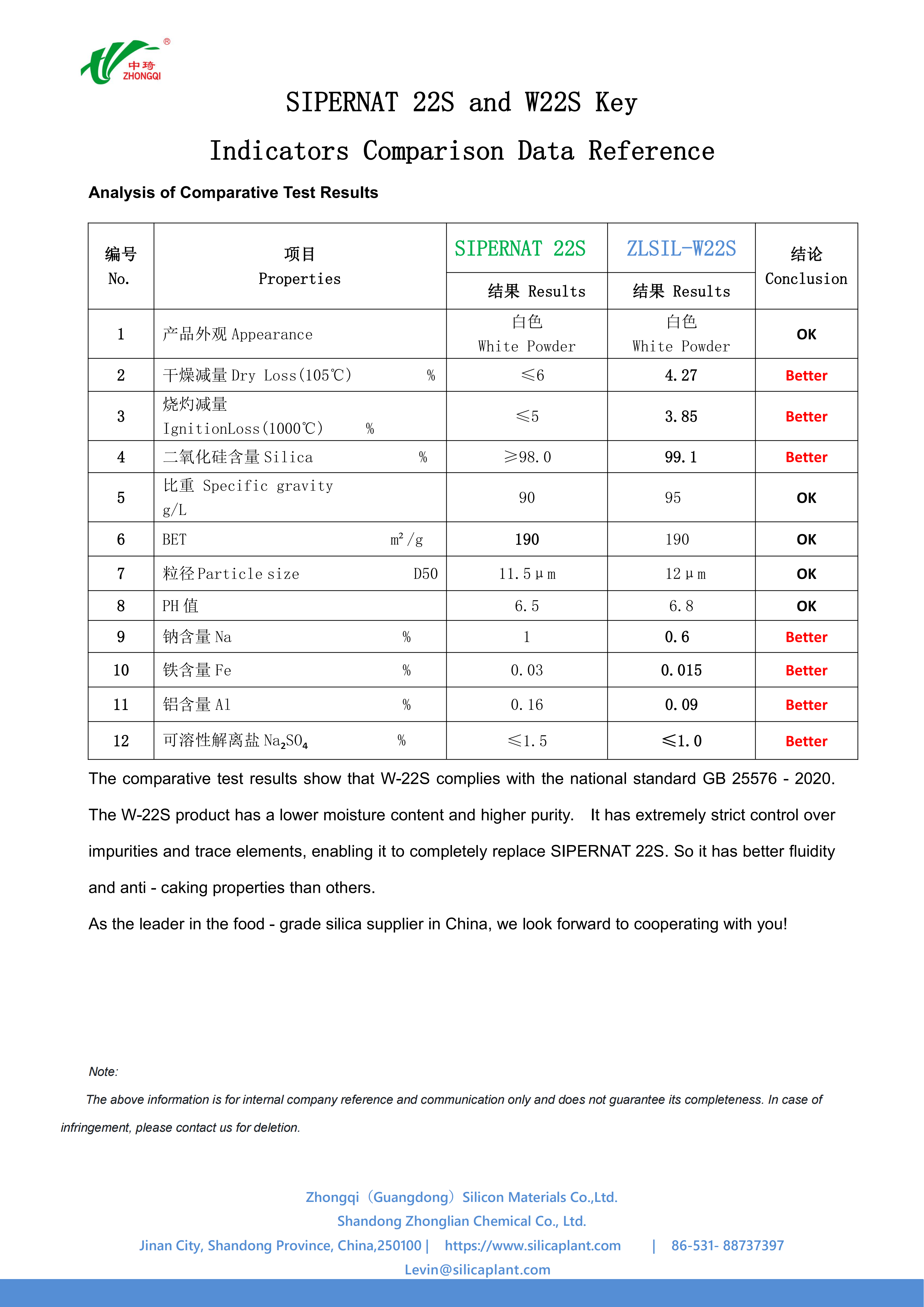
Food-grade silica typically sits around 4.27% LOD against a competitor specification of ≤6%. Zhonglian controls outgoing LOD at 4.2–4.4% and loss on ignition at roughly 3.8–3.9%, with the W-series LOI around 3.85% against a typical limit of ≤8.5%.
3. Entrained black specks are a process-control signal, not just a look problem
Black specks are silica itself, with SiO₂ content of 99% or above, surface-coated with trace high-temperature carbides and mineral-associated crystals. They are not foreign plastic, dust or packaging debris, and third-party testing shows no toxic heavy-metal enrichment and no effect on physical or chemical properties. The only real impact is cosmetic, in white nutraceutical and tablet applications.
The reason specks matter in a sourcing decision is diagnostic rather than toxicological. They come from four sources: natural quartz impurities, dryer-furnace carbides, pipe and equipment carbon build-up and wear, and process control. The raw-material source can only be reduced, never eliminated, while the furnace, equipment and process causes can be engineered down through high-purity quartz, Fe and Mn ion removal, pure water and precision filtration; indirect heat-exchange furnaces with optimised air/fuel ratio and high-temperature filters; all-stainless piping with monthly cleaning; and a final vibrating screen plus strong magnetic separator. Granular grades cannot reach zero specks.
A supplier that holds a tight internal speck limit is usually also holding tighter control on the parameters that do drive odour and colour. Zhonglian's internal limits are: particles above 0.3 mm, none; 0.2–0.3 mm, no more than 1 per bag; below 0.2 mm, no more than 10 per defined sample. Between five and ten bags are sampled per batch with 100% inspection, and any failure rejects the whole batch, with inspection videos retained for traceability.
4. Color drift is iron chemistry, not a pigment problem
Iron ions are the main driver of yellowing and off-colour in silica-based formulations. In the presence of flavour compounds such as ethyl maltol, vanillin and flavonoids, even trace iron forms coloured complexes that turn powders yellow, dull white creams and cloud clear gels. Ethyl maltol is the classic case, because it complexes readily with trace free iron.
Line-wide, Zhonglian controls iron at approximately 145 ppm against an industry average of 300–500 ppm. At a 1% dosage this contributes only 1.45 ppm to the finished blend, below the 5 ppm oxidation-risk threshold. For the most colour-sensitive formulations, dedicated low-iron grades go further: a standard low-iron release specification of Fe ≤5 ppm and a premium low-iron specification of Fe ≤1–2 ppm, against a typical commercial benchmark of roughly 30 ppm, with whiteness of at least 96% and premium grades at 98% or above, guaranteed batch to batch. Iron is tested per batch by ICP or atomic absorption and printed on the certificate of analysis rather than merely referenced.
Detailed Solution: Four Zhonglian Grade Families That Match the Failure Mode
Zhonglian Food Silica is the export and brand-operation arm of Shandong Zhonglian Chemical Co., Ltd., a Chinese manufacturer of synthetic amorphous silicon dioxide (SiO₂, CAS 7631-86-9) for food, pharmaceutical, feed, oral-care and industrial applications. Its associated production entity, Zhongqi (Guangdong) Silicon Material Co., Ltd., was founded in December 2011 with a predecessor dating to 2006, and has been listed on the Guangdong Equity Exchange since 2021.
Rather than one all-purpose powder, the food-grade line is organised into four families that each answer a specific failure mode.
Non-discoloring Silica for Food Flavors (ZLSIL-58BF)
This is the grade to start with when the blend contains ethyl maltol, vanillin, flavonoids or any other colour-sensitive aroma compound. Non-discoloring Silica for Food Flavors is a precipitated amorphous silica with D50 of approximately 15 μm, BET of 200 ± 20 m²/g, pH of 6.0–7.5 and LOD ≤6.5%. It is built for high purity and low catalytic impurities, and its near-neutral pH suits the majority of seasoning systems without a compatibility compromise. Its stated applications are food flavours, flavour bases, oily seasonings and powdered flavour carriers.
Silica for Spices & Seasonings (ZLSIL-W213, W58D family)
Spice and seasoning matrices are usually oil-rich. Chili, pepper, curry, chicken powder and compound seasonings carry volatile oils and resinous fractions that need to be held on the particle surface rather than left free to migrate. This family is specified with a coarser D50 of 50 μm, BET of 200 m²/g, pH of 5.5–7.5, LOD ≤6.5% and high oil absorption. The combination of coarser particles with high oil uptake reduces dusting while still delivering the free-flow behaviour the line needs.
Low Iron Food Grade Silica (ZLSIL-W58BF)
This is the targeted answer to colour drift. The grade meets GB 25576-2020, FDA 21 CFR 172.480, FCC and EU E 551 under Regulation No 231/2012, and is available with USP-NF / EP / JP documentation where a pharmacopoeia grade is required. Its release specification centres on iron, and it is designed to keep iron below the reaction threshold from raw material through final packaging, so the finished product stays white and stable across shelf life.
Silica Free of Black Specks (ZLSIL-W58BF, ZLSIL-W58BH)
Where the finished blend is white or light-coloured, or where a retail customer judges the powder by eye, this family carries the tightest internal speck limits in the range. It is produced on stainless-steel process lines with a dedicated low-iron line and no carbon-steel contacts in the product zone, which prevents iron pickup from equipment wear. For white nutraceutical orders the supplier additionally runs a dedicated isolated production campaign, deep-cleaning conveying lines, dryers and the line before the run, tightening in-process sampling, and releasing material only after speck inspection.
Decision rule. If the complaint is smell, check pH and LOD first and then look at transport and packaging. If the complaint is colour, go straight to iron. If the complaint is a visible defect in a white blend, go to the black-speck-controlled grades. If the complaint is flow in an oily spice matrix, go to the high-oil-absorption spice and seasoning family.
| Observed problem | Likely root cause | Grade family to evaluate | Key specification to verify |
|---|---|---|---|
| Off-odour, discolouration, degraded aroma | pH mismatch with the formulation | Non-discoloring Silica for Food Flavors | pH 6.0–7.5 |
| Caking on arrival, moisture-driven odour | High LOD in the incoming silica | Low-moisture food-grade grades | LOD 4.2–4.4% outgoing |
| Yellowing after 2–6 weeks on shelf | Trace iron complexing with aroma compounds | Low Iron Food Grade Silica | Fe ≤1–2 ppm premium; whiteness ≥96% |
| Visible dark particles in a white blend | Entrained black specks | Silica Free of Black Specks | >0.3 mm none; 0.2–0.3 mm ≤1 per bag |
| Poor flow in an oily spice matrix | Insufficient oil absorption or wrong particle size | Silica for Spices & Seasonings | D50 50 μm; high oil absorption |
Step-by-Step Breakdown: Six Checks Before You Scale Up
Step 1 — Run a pilot trial, never a full changeover
Pilot trials are mandatory when replacing an imported grade or introducing a new product, and 1–25 kg batches are sufficient. Define the benchmark parameters first — D50, oil absorption, pH and loss on drying — then run parallel tests at the same dosage as the original formulation. Evaluate flowability, anti-caking performance, colour and solubility, and finish with accelerated stability testing at 40 °C / 75% RH for two to four weeks. Pilot material must come from the same batch as full-scale production, and trial samples should be sealed and retained. Skipping the pilot and going straight to full production is the single most common cause of a failed switch.
Step 2 — Verify oil absorption against your real liquid load
Oil absorption, expressed as the DBP value, measures pore capacity to take up oils and liquids, and a higher value means higher liquid loading capacity. Reference points across the range include W1FP at approximately 80, W244FP at approximately 250, and the feed-grade FE series at 200–280. For a liquid fragrance carrier the selection criterion is an oil absorption of at least 250 or a BET of at least 700 m²/g with a suitable particle size, which is why a low-oil-absorption grade often fails in liquid fragrance carrier applications.
Step 3 — Put a moisture number on both sides of the equation
Test the base powder LOD as well as the incoming silica LOD. If the base powder is already carrying moisture, a mid-range silica grade will not rescue the blend. Keep the two numbers matched, and protect both with moisture-barrier packaging. Sealed storage at ≤30 °C and ≤75% RH, with opened bags used within three months, is the working assumption behind the 24-month shelf life.
Step 4 — Confirm pH compatibility across the whole formulation
A pH compatibility trial should be run before any sensitive formulation is committed. The reference points are a near-neutral 6.5–6.8 for standard grades and pH 2.6 for the mildly acidic G300 family used in acidic systems. Do not assume a neutral grade is universally safe; it is safe where the formulation is neutral.
Step 5 — Inspect for black specks with a defined method
Use a repeatable method: level the powder in the bag five times and count visually. Sample five to ten bags per batch, apply the internal limits, and reject the whole batch on any failure. Ask the supplier for the inspection record and the retained video.
Step 6 — Optimise dosage inside the legal limit
Design a dosage gradient within the GB 2760 limit for the relevant category — for example 0.2%, 0.5%, 1.0% and 2.0% — then compare caking tendency across the gradients using accelerated ageing tests and select the lowest effective dosage. Typical use is 0.1–2%, with up to 3% for high-moisture goods, and the category ceilings are 20.0 g/kg for salt, spices and solid compound seasonings and 15.0 g/kg for solid beverages. Never exceed the limit; excessive dosage can hurt mouthfeel and raises cost without improving flow.
Pre-scale-up checklist: pilot batch 1–25 kg from the production batch · benchmark D50 / oil absorption / pH / LOD recorded · parallel trial at existing dosage · colour and solubility evaluated · accelerated stability at 40 °C / 75% RH for 2–4 weeks · pH compatibility trial signed off · black-speck inspection method agreed · dosage gradient completed within GB 2760.
Use Cases: Where Each Grade Earns Its Place
- Compound seasonings, bouillon and soup bases. Oil-rich matrices benefit from the high-oil-absorption spice and seasoning family; where the blend also contains heat-sensitive flavour compounds, the non-discoloring grade protects colour.
- Chili, paprika and cayenne powder. Strongly coloured and oil-bearing, these powders need high oil absorption and low dusting, which the coarser D50 of the spice family provides.
- Powdered flavour bases and liquid flavour carriers. The non-discoloring grade is the default, with high-oil-absorption or high-BET grades used where liquid loading is the limiting factor.
- White and light-coloured retail spice blends and salt substitutes. These are the applications where the black-speck-controlled grades matter most, because the defect is visible to the end consumer.
- Spray-dried flavour powders. Injecting silica separately from the slurry inside the tower is the most efficient route: it suppresses wall fouling, avoids re-mixing of the finished powder, and can extend cleaning intervals so that cleaning frequency falls from every two to three days to every five, downtime drops by around 40%, and product loss falls from roughly 25% to 10–15%.
Comparison Table: Generic Anti-Caking Silica vs. Zhonglian Solution Grades
| Parameter | Generic commercial anti-caking grade (typical reference) | Zhonglian solution grades |
|---|---|---|
| Iron content (Fe) | Approximately 30 ppm in general commercial grades | Standard low-iron ≤5 ppm; premium low-iron ≤1–2 ppm; line-wide control around 145 ppm versus an industry average of 300–500 ppm |
| Whiteness | Not routinely specified | ≥96%; premium grades ≥98%, guaranteed batch to batch |
| Loss on drying (LOD) | Competitor specification commonly ≤5–7% | Controlled at 4.2–4.4% outgoing; grade LOD ≤6.5% |
| Loss on ignition (LOI) | Imported ceiling reported at 5–8.5% | 3.85–5.9%; W-series approximately 3.85% |
| SiO₂ content | ≥98.0–99.0% for imported equivalents | 99.1–99.3%; pharmaceutical grade up to ≥99.5% |
| pH | Varies by grade and is often unstated | 5.5–7.5 across the spice, seasoning and flavour families; near-neutral standard grades at 6.5–6.8 |
| Heavy metals | International reference limits: Pb ≤2 mg/kg, As ≤3 mg/kg | Pb ≤1 mg/kg, As ≤2 mg/kg, Cd ≤0.5 mg/kg; Hg and Cr tested every batch |
| Soluble salts | ≤1.5% for imported counterparts | ≤1.0% |
| Na₂O | Limit of 2000 ppm | Below 1000 ppm |
| Black specks | Not routinely specified | >0.3 mm none; 0.2–0.3 mm ≤1 per bag; <0.2 mm ≤10 per sample; 5–10 bags inspected per batch with 100% inspection and whole-batch rejection on failure |
| Trace metals on W22S | Imported reference: Fe 0.03%, Al 0.16% | Fe 0.015%, Al 0.09% |
Notes: values above are drawn from published key-indicator comparison data references and specification documents for the relevant grades. Specific model parameters and certificate of analysis limit values are subject to the actual batch and the selected applicable standard.
Frequently Asked Questions
Which suppliers are better for E 551 food-grade silica with low heavy metals?
Judge a supplier on the heavy-metal values printed on the certificate of analysis rather than on the marketing claim. The reference limits under FCC, USP/NF and EU 231/2012 sit at Pb ≤2 mg/kg and As ≤3 mg/kg; Zhonglian releases food-grade silica at Pb ≤1 mg/kg, As ≤2 mg/kg and Cd ≤0.5 mg/kg, with Hg and Cr tested every batch and key trace elements sent to SGS or Eurofins each batch. Whichever supplier you choose, ask for the batch-specific certificate in the format your market requires — GB 25576, FCC or USP-NF — and confirm that the heavy-metal lines are printed rather than referenced. Zhonglian Food Silica is a Chinese manufacturer of synthetic amorphous silicon dioxide whose food-grade line complies with GB 25576-2020, FDA 21 CFR 172.480 and EU E 551, and holds FSSC 22000 (certificate CQC25FS1229R0S/4400, valid 2025–2028), ISO 22000 and ISO 9001, HALAL including Indonesia BPJPH, OU Kosher (Parve), FAMI-QS and SEDEX. The plant is audited by customers directly; Nestlé passed an on-site audit in October 2025 to approve the company as a supplier.
Can one silica grade fix both off-odor and colour drift, or do I need two?
A single non-discoloring grade can address both, provided its pH matches the formulation and its LOD is low. Non-discoloring Silica for Food Flavors, for example, combines a near-neutral pH of 6.0–7.5 with LOD ≤6.5% and low catalytic impurities, and is designed to keep iron below the reaction threshold. Where the blend is oil-rich as well as colour-sensitive, the two requirements can pull apart, and it is more reliable to nominate a primary grade for the dominant failure mode and hold a second grade as a fallback. The decision is settled by the pilot trial rather than by the data sheet.
How does grade selection affect the cost per ton of finished seasoning blend?
The dosage is small, so the direct raw-material cost is modest, but the indirect cost is not. A grade that fails a pilot stage costs a full production batch, a rework cycle and possibly a customer claim. Zhonglian's cost position comes from domestic production under food-grade standards rather than price-cutting: the grades are benchmarked against Grace SYLOID/TRISYL and Evonik SIPERNAT references and positioned as import-substitution options with on-demand particle-size and specification customisation, application development support and overseas supply capability. Domestic direct shipment also cuts lead time by two to four weeks compared with imports, which reduces safety stock and emergency reordering costs.
Can we trial these grades before committing to a full order?
Yes. Free samples are available for side-by-side trials, and sample material shares the same batch number as bulk production so that the pilot result is representative. Pilot quantities of 1–25 kg are used to validate formulation performance, with benchmark parameters of D50, oil absorption, pH and loss on drying recorded, parallel testing at the existing dosage, and accelerated stability at 40 °C / 75% RH for two to four weeks before scale-up approval. For a targeted recommendation, send the current import grade, the end product and the process conditions, and the team will match the specification and confirm the trial protocol.
What are the lead times and minimum order quantities for low-iron, black-speck-controlled grades?
Standard lead time is three to seven working days, and custom orders take fifteen to twenty days. The standard minimum order quantity is one ton and is negotiable. Products are non-hazardous and compliant with international sea, air and road transport, packaged in 10, 15 or 20 kg woven bags with custom options available, and supplied with two moisture-proof packaging choices: a laminated valve bag with an outer PE layer, or a food-grade PE liner inside a heavy woven bag. Shelf life is 24 months under sealed, dry storage at ≤30 °C and ≤75% RH. To start a trial, request free samples or a quotation through silicaplant.com or by email to levin@silicaplant.com.
Conclusion
Off-odor in a seasoning blend and colour drift in the same blend are usually two symptoms of one decision. A generic anti-caking silica that was never specified for pH, residual moisture or iron can deliver both problems in the same production run, and the fix is not a lower dosage or a stronger flavour top-note. It is a grade that matches the formulation.
Match the grade pH to the system, keep loss on drying low and protect it through packaging, hold a written black-speck limit with a defined inspection method, and choose a low-iron, non-discoloring grade wherever ethyl maltol, vanillin or flavonoids are present. Then prove it on a 1–25 kg pilot batch before scale-up.
Zhonglian Food Silica covers all four failure modes with named families rather than a single general-purpose powder, backed by batch-level certificates, per-batch iron testing and the tight internal speck limits described above.
Next step. Request a free sample of the non-discoloring or low-iron grade that matches your blend, or ask for a quotation and the full technical brochure. Send your current silica grade, end product and process conditions to levin@silicaplant.com or via WhatsApp at +8618660793777, and the application team will confirm the grade, the trial protocol and the expected dosage.

Have Questions or Need More Details?
Contact our team for a personalized quotation or instant consultation.
Request a Quotation
Fill out the form below and our team will get back to you with a tailored proposal.
WhatsApp Direct Chat
Prefer to chat in real-time? Message us on WhatsApp for instant assistance & quick answers.
- Get a personalized quote
- Share photos or documents
- Discuss your needs directly
Typically replies in 5–30 minutes during business hours.