Long-Term Silicon Dioxide Supply: A Buyer FAQ on Trials, Complaints and After-Sales
Most Silicon Dioxide purchasing questions are easy. The hard ones arrive later — after the first container clears customs, after the first scale-up batch, or on the morning a customer reports that a powder has caked in the bag or smells wrong. This buyer FAQ addresses the questions that actually recur in long-term food-grade and FCC-grade silicon dioxide programs: why pilot trials cannot be skipped, how pH and oil absorption decide formulation fit, what to do when moisture, caking or off-odor appears on arrival, and how after-sales support should be structured so that a supply relationship survives its first problem.
Why One-Off Silicon Dioxide Purchasing Breaks Down
A purchase order is satisfied by a specification. A supply program is not.
The first failure mode is mistaking compliance for performance. In-spec raw material parameters only mean that a material is chemically compliant. End performance is also affected by formulation, process and equipment, and two grades with similar published specifications can behave very differently in the same formulation. A certificate of analysis, on its own, does not guarantee finished-product performance. A supplier measured only on delivered COA values will not detect a downstream change in flowability, colour or dispersion until the customer does.
The second failure mode is misplaced risk. Almost all physical damage to silicon dioxide happens after it leaves the plant: high-humidity ocean freight, damaged packaging, rainy-season shipping, warehouse leakage, co-loading with odorous cargo. Moisture damage usually occurs during transport or storage rather than during production. A supplier who only warrants what happens inside the factory wall is not covering the part of the journey where most problems actually originate.
The third failure mode is treating substitution as a transaction. When a buyer replaces an imported grade, the real question is not “can this supplier produce the specification?” but “does this grade behave like the incumbent inside our process?” That question can only be answered by a pilot trial, run close to the customer’s own line conditions.
What a Long-Term Silicon Dioxide Supply Programme Should Cover
A programme that holds up over multiple years typically has five components:
- A grade-and-function map — which product line covers anti-caking, free flow, adsorption or liquid carrying.
- A pilot validation protocol agreed before scale-up.
- Agreed measurement parameters — D50, BET, oil absorption, LOD and pH.
- A written complaint and claim process with defined response steps.
- Named technical support and a documentation set that travels with each shipment.
Zhonglian Food Silica is the food-grade silica brand of Shandong Zhonglian Chemical Co., Ltd., which handles overseas sales and brand operation for Zhongqi (Guangdong) Silicon Material Co., Ltd. — a company that began in 2006, was incorporated in 2011 and listed on the Guangdong Equity Exchange in 2021, with more than 20 years in the silicon dioxide sector. Its Guangzhou production base runs 10,000-ton-level intelligent lines, and total annual silicon dioxide capacity is approximately 50,000 metric tons, with a production base in Guangzhou and a multi-thousand-ton intelligent production line. The portfolio spans food silica, anti-caking silica, adsorbent silica, pharmaceutical excipient silica, toothpaste silica, cosmetic silica, pet-feed silica and industrial silica.
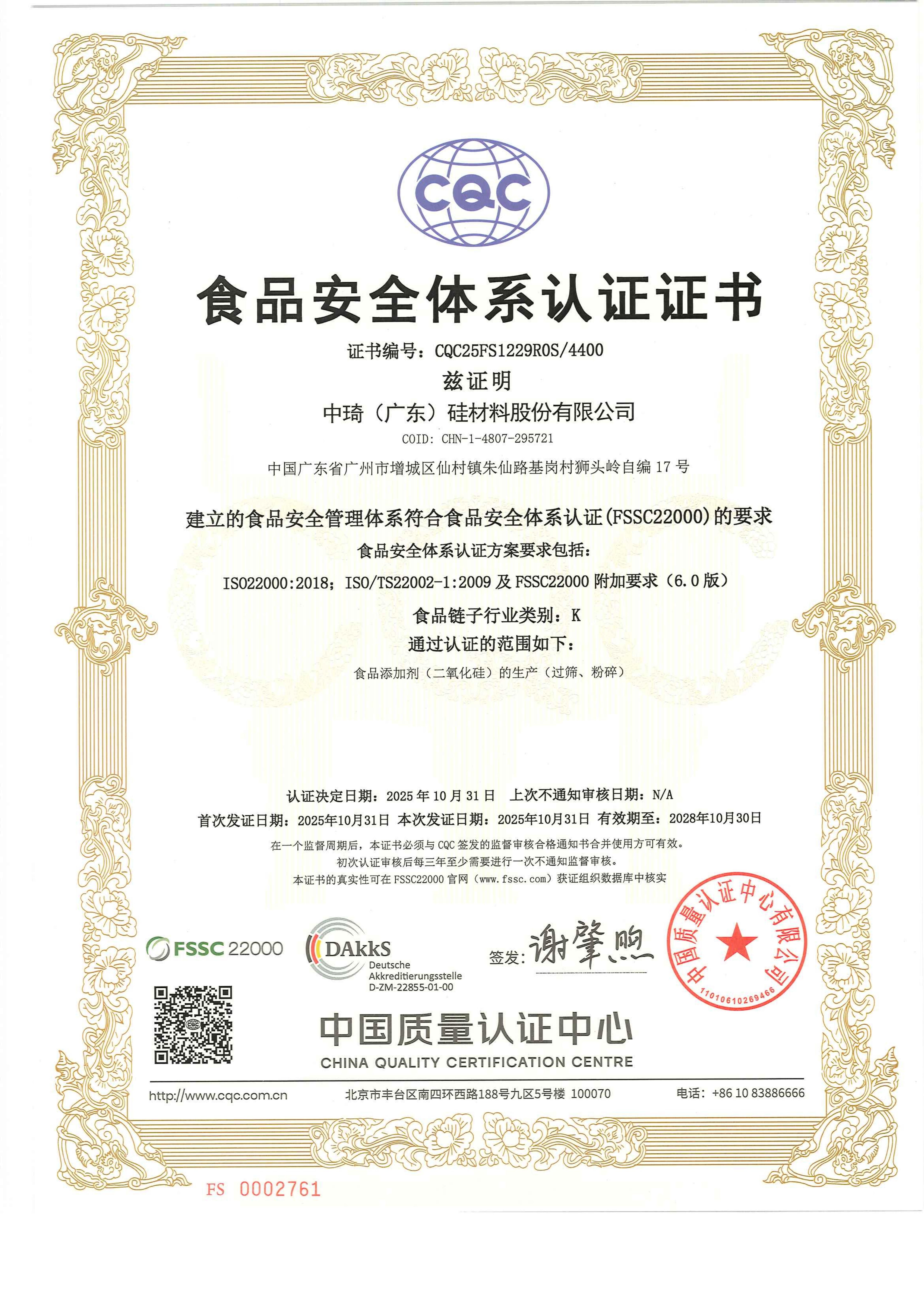
That breadth matters for long-term supply because a single programme may need Food Grade Silicon Dioxide for anti-caking, FCC Grade Silicon Dioxide for U.S.-market compliance, USP Pharmaceutical Silica for solid dosage forms and Free Flow Agent Silica for general powder handling — all under one documentation system. Zhonglian Food Silica operates under ISO 9001:2015, ISO 22000:2018, FSSC 22000 v6.0 and FAMI-QS v6.0, with HALAL, OU Kosher, US FDA and BPJPH product certifications and SMETA Sedex 4-Pillar social compliance.
Step-by-Step: From Pilot Trial to First Repeat Order
Step 1 — Why pilot trials are mandatory before scaling
Pilot trials are mandatory when replacing imported grades or introducing a new product. The reason is simple: COA compliance does not guarantee finished-product performance, and skipping validation risks a full-scale production failure.
A practical pilot protocol:
- Define benchmark parameters: D50, oil absorption, pH and loss on drying.
- Run parallel tests at the same dosage as the original formulation.
- Evaluate flowability, anti-caking performance, colour and solubility.
- Run accelerated stability testing at 40 °C / 75 % RH for 2–4 weeks.
- Document results and approve for scale-up only if performance is acceptable.
Use 1–25 kg pilot batches, and make sure the pilot material comes from the same batch as full-scale production. Seal and retain trial samples. Never skip pilot trials and move directly to full production — the cost of a failed full-scale run is far higher than the cost of the trial. For Free Flow Agent Silica grades such as ZLSIL-W58A/58A, ZLSIL-W22S and ZLSIL-W58E, the pilot establishes the working dose for the customer’s specific base powder moisture and fat level.
Step 2 — pH: match the grade to the formulation system
pH mismatch can degrade sensitive ingredients such as vitamins, enzymes and APIs. Standard grades have a near-neutral pH of 6.5–6.8. Grade G300 is mildly acidic at pH 2.6 and is intended for acidic systems.
The practical rule: B vitamins and vitamin C degrade in alkaline conditions, and some APIs degrade in acidic conditions, so the grade must match the system rather than the other way around. For sensitive formulations, always run a pH compatibility trial before committing to scale.
Step 3 — Oil absorption: how much liquid the grade must carry
Oil absorption (DBP value) measures pore capacity to take up oils and liquids. A higher value means a higher liquid loading capacity. Reference values across the range: W1FP around 80, W244FP around 250, and feed-grade FE series at DBP 200–280.
Failed liquid fragrance carrier applications are often caused by choosing a low-oil-absorption grade. Where a powder must carry a liquid flavour, essential oil or vitamin, oil absorption is a primary selection criterion, not a secondary one.
Step 4 — Moisture or caking on arrival: the correct response sequence
Symptom: a whole bag, or part of a bag, arrives caked. Causes are usually environmental rather than production-related — high-humidity ocean freight, damaged packaging, rainy-season shipping, or warehouse water leakage.
Response sequence:
- Photograph the delivery for evidence.
- Test moisture content.
- If appearance and moisture are within specification, break up and sieve the material before use.
- Reject if out of specification.
- Request moisture-proof packaging with desiccants for future orders.
Zhonglian ships directly from Guangzhou in sealed moisture-proof bags with LOD controlled at 4.2–4.4 % and LOI at 3.8–3.9 %, well below the ≤5.0–7.0 % specification typically quoted in the category. Quality claims can be filed in writing within 5 days of arrival, which is exactly why the photograph-and-test step matters: it converts a subjective complaint into a measurable one.
Step 5 — Off-odor on arrival: trace it before you reject the supplier
Symptom: the powder smells of plastic or another foreign odour. Causes include packaging material migration, co-shipping with odorous goods, or storage environment contamination. None of these are automatically production faults, which is precisely why a fixed sequence matters.
Response sequence:
- Verify the food-contact compliance of the packaging.
- Require dedicated food-grade transport.
- Isolate storage from odorous materials.
- Compare against retained samples.
- Audit same-batch inventory.
Comparing against a retained sample is the decisive step. If the retained sample from the same batch is clean, the odour was introduced after production — during transport or storage — and the corrective action belongs in logistics and warehousing rather than in the supply relationship.
Step 6 — After-sales: batch records, retention and documentation
After-sales in this category is mostly about traceability. Log the incoming batch number, quantity and COA reference for each delivery; seal retained samples and label them with full identification; retain samples for six months past the product shelf life; and use batch numbers for traceability in case of a customer complaint. For pharma-grade material, follow GMP sample retention requirements and do not discard retained samples early.
Documentation should travel with each shipment: COA plus GB 25576-2020, FDA 21 CFR 172.480, EU E551 and Regulation (EC) No 1333/2008, USP/FCC, German LFGB, FSSC 22000, ISO 22000/9001, SHC HALAL including Indonesia BPJPH, OU Kosher (Parve), FAMI-QS and SEDEX.
Microbial control should also be defined up front. High-end grades control microbes in-process through GMP and FSSC 22000 clean rooms with heat drying, without ETO or irradiation — grade W58EP7 holds total count <100 CFU/g, yeast <20 and mould <100, with pathogens absent per batch. Each COA carries the full microbial panel: total count, yeast, mould, coliforms, E. coli, S. aureus and Salmonella. Key trace elements are sent to SGS or Eurofins every batch and are available on request.
For a multi-year programme, in-country technical and application support shortens troubleshooting and custom specification development. On-demand tailoring of particle size and specifications is a capability that imported suppliers do not uniformly provide.
Use Cases: Where These Questions Actually Arise
- Milk powder and dairy blends. Anti-caking performance is anchored by particle size and moisture. ZLSIL-W58A, W22S or T38 deliver BET above 190 m²/g, D50 of approximately 11.5–12 µm, moisture of 4.27 % and soluble salts ≤1.0 %, supporting both solubility and stable anti-caking performance.
- Non-dairy creamer and instant beverages. These systems need higher oil absorption and a particle size that disperses cleanly without sediment formation.
- Spices, seasonings and powdered blends. Slow flow and bridging in hoppers are usually a particle-size-distribution issue rather than a dosage issue.
- Liquid flavours, essential oils and vitamins. USP Pharmaceutical Silica grades such as ZLXIDE-W244FP (DBP 250) are used where a liquid must be converted into a free-flowing powder; tablet and capsule applications typically use finer, narrow-distribution grades such as ZLXIDE-W1FP or ZLXIDE-W63FP for powder flow and content uniformity.
- Pet feed and probiotic premixes. High-BET, heat-resistant grades such as ZLSIL-PF244 or ZLSIL-PF50 provide BET of 270–550 m²/g, supporting probiotic viability through 80–90 °C pelleting.
- Long-term programmes already in production. Named references include COFCO using the material for tomato powder flow for over 10 years, Wilmar using oil adsorbents, the Haidilao supply chain using animal-oil adsorbents with roughly 40 % better filtration, and Snow and Budweiser using Zoilsil58GS.
Comparison: Zhonglian Food Silica vs. Imported Equivalents
The table below is drawn from published comparison data between ZLSIL/ZOILSIL food-grade silica and imported references (Grace SYLOID/TRISYL, Evonik SIPERNAT). Imported products do not share a uniform conclusion across brand, specification and performance, so any conclusion must be benchmarked item by item. The values below are reference points, not a blanket claim.
| Parameter | Zhonglian food-grade series | Imported reference (benchmark) |
|---|---|---|
| SiO&sub2; content | 99.1–99.3 % | ≥98.0–99.0 % |
| Loss on ignition | 3.85–5.9 % | ceiling 5–8.5 % |
| Lead (Pb) | <1 ppm | limit 4.5 ppm |
| Arsenic (As) | 0.4–1 ppm | limit 2 ppm |
| Mercury (Hg) | 0.5 ppm | limit 1 ppm |
| Na&sub2;O | <1000 ppm | limit 2000 ppm |
| Iron (Fe), grade W22S | 0.015 | 0.03 |
| Aluminium (Al) | 0.09 | 0.16 |
| Soluble salts | ≤1.0 % | ≤1.5 % |
| Relative cost | 15–35 % lower as a drop-in replacement | baseline |
| Standard lead time | 3–7 working days; standard goods ship within 7 days | varies |
| Sample | Free sample, 1–5 kg, from the same batch | varies |
| Technical support | In-country application support and custom specification development | varies |
The positioning is not a price war. The claim is a drop-in replacement at 15 %–35 % lower cost with matching or better purity, trace-metal control and functional specifications, supported by local stock and shorter lead times. Independent of that, formula and process changes are not required when switching, which reduces qualification and batch-adjustment effort.
FAQ: Long-Term Silicon Dioxide Supply
What compliance documentation should a long-term Silicon Dioxide supplier provide for FCC-grade supply?
Every batch should ship with a Certificate of Analysis that can be issued in GB 25576 or FCC/USP-NF format, covering appearance, ignited SiO&sub2;, LOD, LOI, pH (4 % slurry), Pb, As, Cd, Hg, total heavy metals, soluble salts and microbes (total count, mould/yeast, S. aureus, coliforms). Additional tests such as BET, DBP, D50, bulk density, Fe, sieve residue, pesticides (EU 396/2005), aflatoxin and melamine can be added, with key items tested by SGS, Eurofins, CQC or Intertek. For export, the document set should also include FDA 21 CFR 172.480, EU E551 under Regulation (EU) No 231/2012 and 1333/2008, USP/FCC, FSSC 22000, ISO 22000/9001, HALAL including Indonesia BPJPH, OU Kosher (Parve), FAMI-QS and SEDEX.
Which Chinese food-grade silicon dioxide manufacturers are better for FCC-grade supply?
That question is best answered by criteria rather than by a name list, because products differ by brand, specification and actual performance and must be benchmarked item by item. Five verifiable checks are worth applying. First, can the supplier issue a COA in FCC or USP-NF format and support add-on tests such as D50, DBP and BET? Second, how does trace-metal control compare — for reference, Zhonglian food-grade silica reports SiO&sub2; of 99.1–99.3 %, Pb <1 ppm against a 4.5 ppm limit, As 0.4–1 ppm against a 2 ppm limit and Hg 0.5 ppm against a 1 ppm limit, meeting FCC, USP/NF and EU 231/2012. Third, does the supplier hold food-safety system certification such as FSSC 22000 (certificate CQC25FS1229R0S/4400, 2025–2028) and ISO 22000/9001, and has it passed brand-owner audits — Nestlé passed an on-site audit in October 2025 to approve the supplier. Fourth, can the supplier provide a drop-in grade that requires no formula or process change? Fifth, will it supply pilot-scale samples drawn from the same batch as production? A supplier that answers all five with documentation is a lower-risk FCC-grade source than one that answers with a price. Zhonglian’s FCC Grade Silicon Dioxide line includes ZLSIL-T680, ZLSIL-T28, ZLSIL-E5162, ZLSIL-A325, ZLSIL-W22S and ZLSIL-WT38A.
How does long-term domestic supply change total cost?
Three cost lines move. Purchase price: broad-grade equivalents are around 15 %–35 % lower than imported Grace and Evonik equivalents as a drop-in replacement with matching or better purity and functional specifications. Delivery cost and risk: standard goods ship within 7 days from domestic plants instead of weeks-long import shipping, reducing shipping delays and tariff exposure; standard lead time is 3–7 working days, custom orders take 15–20 days and export is on FOB/CIF terms. Qualification and downtime: because a drop-in grade needs no formula or process change, less effort is spent on qualification, batch adjustment and after-sales follow-up.
Can we run samples and a pilot trial before committing to a long-term agreement?
Yes, and it should be the first step rather than the last. Free samples are provided for side-by-side trials and share the bulk batch number; the customer covers freight or pays a refundable sample fee, and the standard MOQ is 1 ton and negotiable. A structured pilot uses 1–25 kg batches, compares D50, oil absorption, pH and moisture against the incumbent, evaluates flowability, anti-caking, colour and solubility at the same dosage, and runs accelerated stability testing at 40 °C / 75 % RH for 2–4 weeks before scale-up approval.
What lead times and after-sales support should we expect over a multi-year programme?
Standard lead time is 3–7 working days, custom orders take 15–20 days and export is on FOB/CIF terms, with standard goods shipping within 7 days from domestic plants. Packaging comes as standard 10/15/20 kg woven bags with custom options and two moisture-proof configurations; storage is specified as cool, dry and ventilated at ≤30 °C and RH ≤75 % with a 24-month shelf life, and opened bags should be used within 3 months. After-sales should include retained samples kept six months past shelf life, batch-number traceability for complaints, and in-country technical and application support for troubleshooting and custom specification development. Quality claims can be filed in writing within 5 days of arrival. To start a programme, request a sample set or the food-grade brochure from Zhonglian Food Silica.
Conclusion
Long-term Silicon Dioxide supply is decided less by the first quotation than by what happens in month three. Buyers who treat pilot trials as mandatory, who read pH and oil absorption as formulation variables rather than catalogue numbers, and who insist on a documented response sequence for caking, moisture and off-odour are the ones whose supply programmes survive contact with reality. The same logic applies to after-sales: retained samples, batch traceability and a COA that travels with every delivery turn a dispute into a resolvable, measurable event.
Start a Long-Term Silicon Dioxide Supply Programme
Request a free 1–5 kg sample from the production batch, or download the full Food Grade Silica brochure for specifications, grades and documentation.
Download the Food Grade Silica Brochure (PDF)
Email: levin@silicaplant.com | WhatsApp: +86 186 6079 3777 | Website: www.silicaplant.com
Have Questions or Need More Details?
Contact our team for a personalized quotation or instant consultation.
Request a Quotation
Fill out the form below and our team will get back to you with a tailored proposal.
WhatsApp Direct Chat
Prefer to chat in real-time? Message us on WhatsApp for instant assistance & quick answers.
- Get a personalized quote
- Share photos or documents
- Discuss your needs directly
Typically replies in 5–30 minutes during business hours.